

What Does a HubSpot Virtual Assistant Do? The Essential Weekly Tasks

If someone on your team still has to remember what needs cleaning up, what needs checking, and what is falling behind in HubSpot, you have not really delegated HubSpot yet.
A good HubSpot virtual assistant creates a dependable weekly rhythm that keeps the CRM accurate, current, and useful. That typically means reviewing CRM data, pipeline activity, lead follow-up, workflows, marketing execution, and reporting while flagging anything that needs a higher-level decision.
Today, we’ll break down the essential HubSpot tasks a VA should handle each week, what good ownership looks like, and which responsibilities should stay with a more strategic or technical HubSpot resource.
Key Takeaways
A HubSpot VA’s weekly responsibilities should focus on the recurring work that keeps the CRM accurate, organized, and moving without constant internal oversight. Here’s an overview of their responsibilities:
- Maintain CRM data: Update records, fix duplicates, correct properties, and keep lifecycle stages and ownership accurate.
- Review leads and deals: Check for stale opportunities, overdue follow-up, missing next steps, and records that need attention.
- Monitor HubSpot workflows: Review automations, routing, forms, and other recurring processes for errors or gaps.
- Support reporting and execution: Keep lists, campaigns, dashboards, and routine HubSpot work organized and up to date.
A Good HubSpot VA Maintains the System, Not Just the Task List
HubSpot problems rarely stay small. A few outdated records can weaken reporting. A stale deal can distort the pipeline. A broken workflow can quietly affect dozens of contacts before anyone notices. That is why a strong HubSpot VA should do more than complete assigned tasks. Their weekly role should follow a simple rhythm:
- Maintain what matters: Keep CRM records, pipelines, lists, and routine marketing work current.
- Catch what is slipping: Identify bad data, missed follow-up, stale opportunities, and workflow issues early.
- Escalate what needs judgment: Flag problems that require strategy, technical expertise, or a business decision.
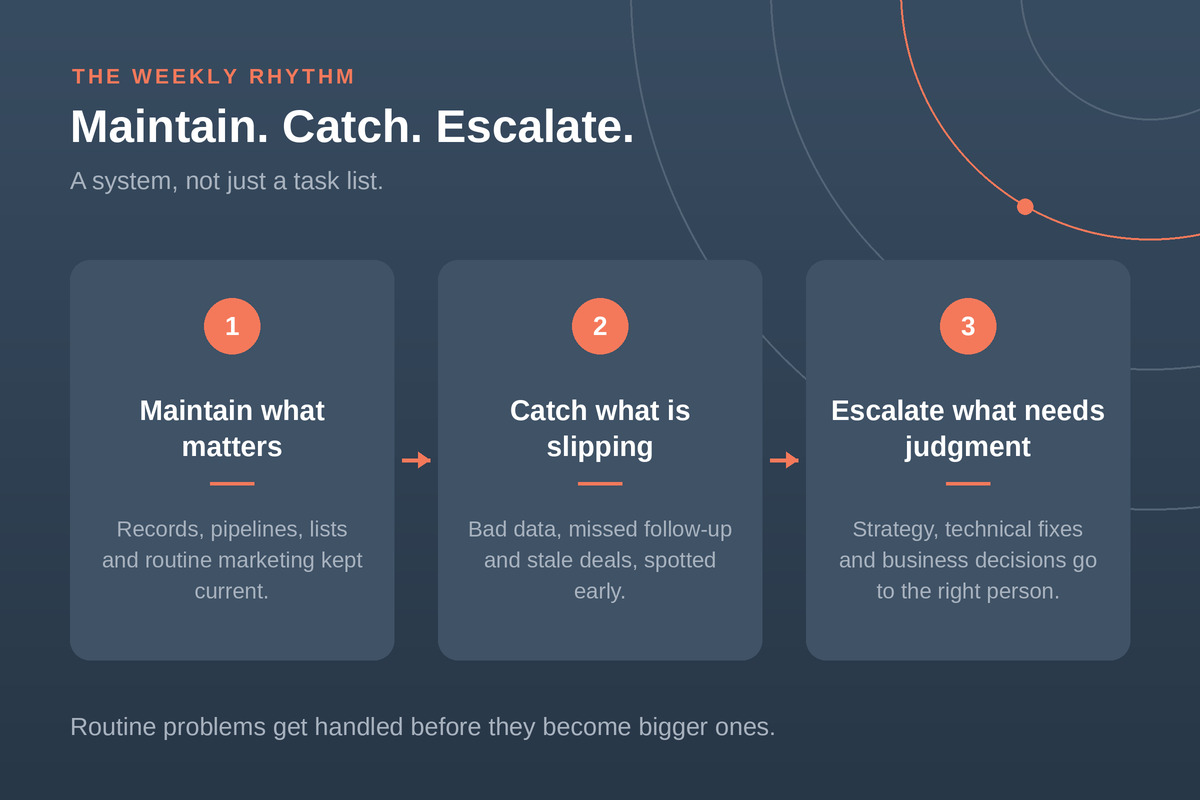
The goal is not to make the VA responsible for everything in HubSpot. It is to make sure routine problems are handled before they become bigger ones.
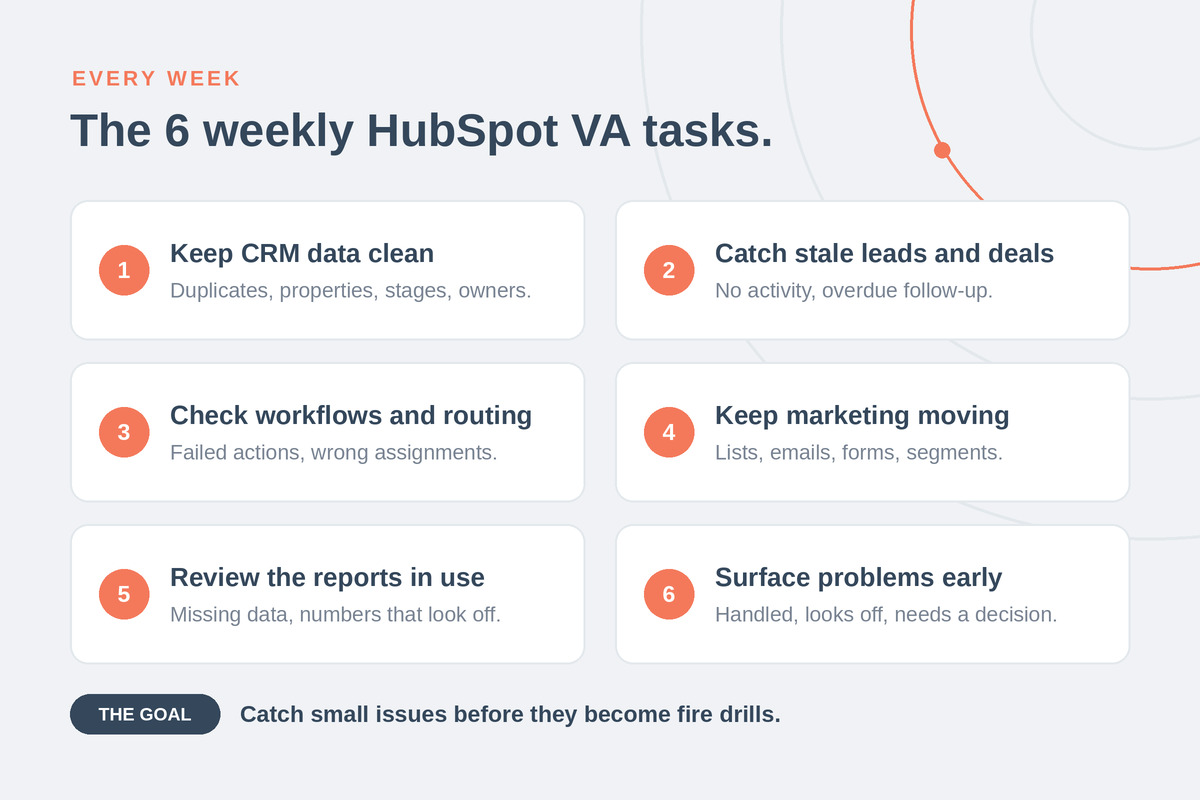
The 6 HubSpot Tasks Your VA Should Do Every Week
A HubSpot VA should have a consistent weekly rhythm that keeps the CRM accurate, the pipeline visible, and routine execution moving. The goal is not to touch every part of HubSpot every week. It is to stay on top of the areas where small issues can quickly create bigger problems.
1. Keep CRM Data Clean and Trustworthy
Your VA should regularly review the records your team relies on and correct obvious issues such as duplicates, incomplete properties, inaccurate lifecycle stages, and ownership gaps.
This matters because CRM data loses value quickly when people stop trusting it. Once teams start keeping important information in inboxes, notes, or separate spreadsheets, HubSpot stops functioning as the shared source of truth.
2. Catch Leads and Deals That Are Going Stale
Each week, your VA should review open leads and deals for signs that something has stalled. That includes records with no recent activity, overdue follow-up, missing next steps, incorrect stages, or no clear owner.
The VA does not need to decide what sales should do next. Their job is to make stalled opportunities visible before they quietly disappear from the pipeline.
3. Check That Workflows and Lead Routing Are Working
Automation can fail quietly. A workflow error, routing issue, or enrollment problem may affect multiple records before anyone notices.
A weekly check should focus on obvious exceptions: failed workflow actions, contacts that did not enroll as expected, incorrect assignments, and form or routing issues. The goal is to catch problems early and escalate anything that requires deeper technical work.
4. Keep Marketing Execution Moving
If marketing support is part of the VA’s role, they can handle the recurring execution work that often slows teams down between campaigns.
This may include maintaining lists, scheduling approved emails, uploading content, checking forms, updating segments, and keeping campaign records organized. The distinction is important: the VA supports execution; they do not need to own the strategy behind it.
5. Review the Reports the Team Actually Uses
Your HubSpot VA should also review the dashboards and reports people rely on regularly. They are not there to perform advanced analysis, but they should notice when something looks wrong.
That means watching for missing data, unusual changes, inconsistent numbers, or metrics that no longer match what is happening in the CRM. A report is only useful if someone notices when the underlying information stops making sense.
6. Surface Problems Before They Become Fire Drills
At the end of the week, a good HubSpot VA should be able to summarize three things:
- What was handled
- What looks off
- What needs someone else’s decision
That simple reporting habit turns task support into operational support. Instead of quietly completing work inside HubSpot, the VA helps the team see what needs attention before small issues become larger ones.
What Should Not Automatically Be a HubSpot VA Responsibility?
A HubSpot VA can own a great deal of recurring execution, but they should not automatically be expected to solve every strategic or technical problem inside the platform.
Work that often requires a HubSpot specialist, RevOps lead, or internal decision-maker includes:
- CRM architecture and major redesigns
- Complex workflow logic and advanced integrations
- Attribution and reporting strategy
- Sales-process design
- Major migrations or system reconfiguration
The key distinction is between spotting the problem and owning the solution.
A strong VA should be able to identify that a workflow is failing, a report is unreliable, or the pipeline structure no longer reflects how the business sells. They should document the issue clearly and escalate it to the right person.
That boundary protects both sides: the business still gets proactive HubSpot support, while higher-risk decisions stay with the people who have the strategy, technical depth, or authority to make them.
The Weekly HubSpot Standard: What Should Be True by Friday?
A good weekly HubSpot routine should leave the system easier to trust, easier to use, and easier for the team to act on.
By the end of the week:
- Important records are current: Key contact, company, lead, and deal information has been updated or corrected.
- Problems are visible: Data issues, stalled opportunities, workflow errors, and reporting gaps have been resolved or clearly flagged.
- Execution is moving: Routine marketing and CRM work is not sitting in a backlog waiting for someone to notice it.
- Nothing is ownerless: Anything that requires a decision, technical fix, or strategic input has been handed to the right person.
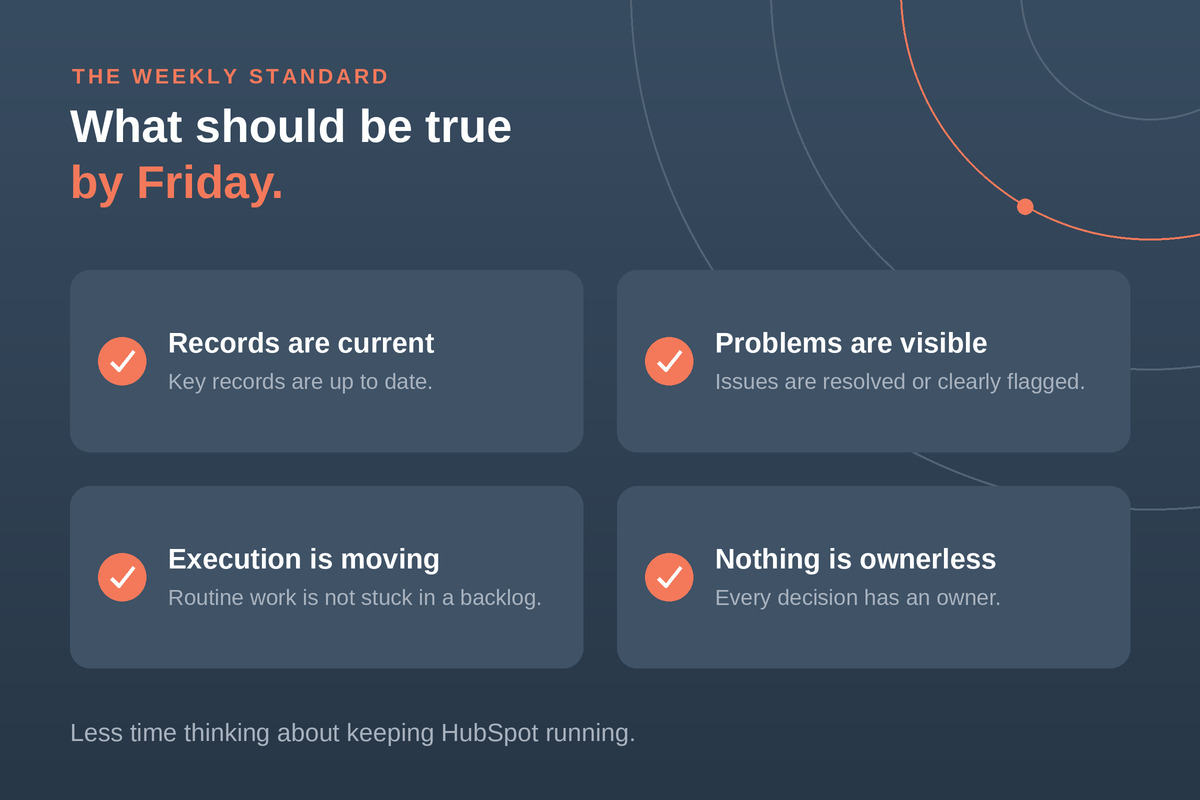
That is the real standard. The question is not whether your HubSpot VA completed enough tasks this week. It is whether your team had to spend less time thinking about keeping HubSpot running because they were there.
Need Help Keeping HubSpot Running Week After Week?
Remember: We Are Working is here for you. Our HubSpot virtual assistants can take on the recurring CRM, pipeline, marketing, and reporting work that keeps pulling your team back into the system. See how We Are Working can give you reliable HubSpot support without adding another full-time hire. Contact us today.
Frequently Asked Questions About HubSpot Virtual Assistants
What does a HubSpot virtual assistant do?
A HubSpot virtual assistant handles recurring CRM and marketing tasks such as updating records, reviewing pipelines, checking workflows, maintaining lists, supporting campaigns, and monitoring reports. Their role is to keep routine HubSpot work moving while flagging issues that need strategic or technical attention.
What HubSpot tasks should a virtual assistant do every week?
Weekly HubSpot VA tasks typically include cleaning CRM data, reviewing stale leads and deals, checking workflows and lead routing, supporting marketing execution, reviewing key reports, and escalating unresolved problems. The exact routine should reflect how your team uses HubSpot.
Can a virtual assistant manage HubSpot CRM?
Yes. A trained virtual assistant can manage many day-to-day HubSpot CRM responsibilities, including record updates, duplicate cleanup, lifecycle stages, deal tracking, lists, and basic reporting. More complex CRM architecture, integrations, migrations, and RevOps strategy may require a HubSpot specialist.
How often should HubSpot CRM be maintained?
HubSpot should be maintained continuously, with a structured review at least weekly for active teams. Regular checks help catch stale records, data-quality problems, workflow errors, and pipeline gaps before they affect reporting or follow-up.
What is the difference between a HubSpot VA and a HubSpot specialist?
A HubSpot VA typically focuses on recurring execution and system upkeep, while a HubSpot specialist handles more advanced technical or strategic work. A good VA should still be able to identify, document, and escalate problems that fall outside their scope.
